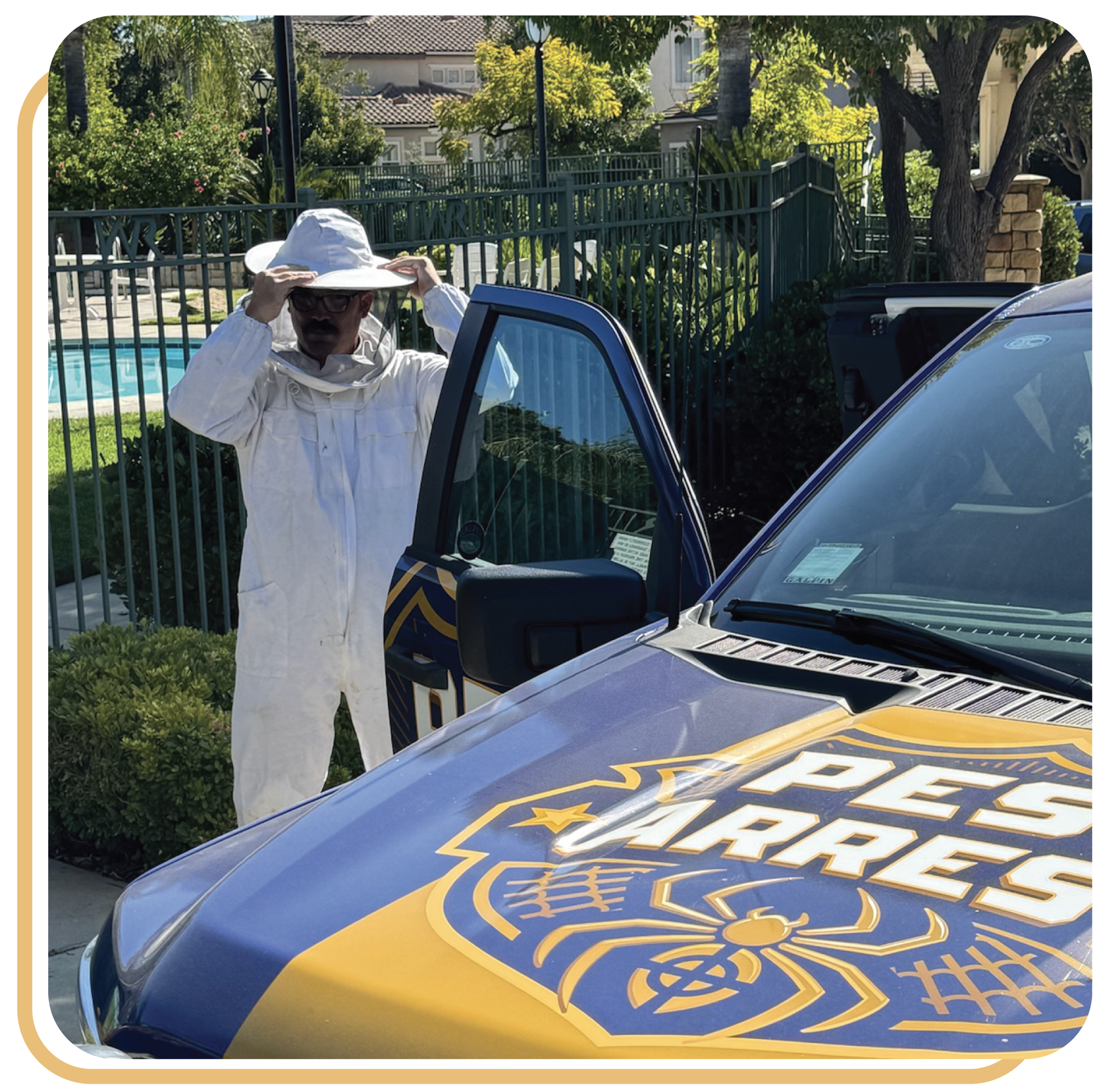
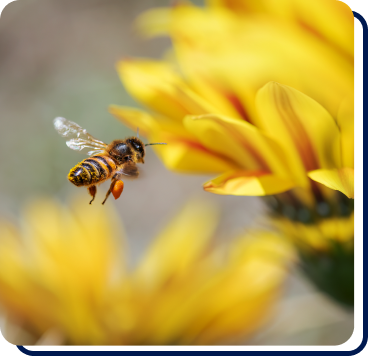
What Happens When You Call About a Bee Problem
Start by telling us where you are seeing the bees, how long the activity has been present, and if anyone has already sprayed, sealed, or disturbed the area. That gives our team useful information before the visit and helps us focus the inspection where activity is strongest.
Our bee service can include:
- Activity assessment: We look at bee traffic, entry points, and surrounding conditions to narrow down where the insects are nesting.
- Nest location: We identify accessible or concealed nesting areas around walls, chimneys, rooflines, trees, insulation, and other sheltered spaces.
- Treatment planning: We choose an approach based on the bee activity, nest location, structure, and conditions at the property.
- Indoor & outdoor treatment: We address bee problems occurring around exterior areas as well as activity connected to the structure.
- Nest-area service: We work around the established nesting location instead of treating random areas where bees happen to be flying.
- Prevention guidance: We explain conditions or openings worth addressing after the active problem has been handled.
- Follow-up when needed: If activity continues after the initial service, we can determine what additional attention the area requires.
Bee Removal Services for Santa Clarita Homes & Businesses
Bee problems can develop in landscaping, trees, exterior structures, or hidden parts of a building. The service needs to fit where the activity is happening and how the insects are interacting with the property.
Our bee removal and control services include:
- Residential bee removal: Address active bee problems around homes, garages, yards, rooflines, and other residential areas.
- Commercial bee control: Help businesses address bee activity that can interfere with entrances, outdoor areas, employees, or customers.
- Wall-void bee control: Investigate repeated bee traffic entering cracks, penetrations, and openings that may lead into wall cavities.
- Chimney bee removal: Address nests or concentrated activity associated with chimney structures and nearby openings.
- Tree bee control: Evaluate bee activity associated with hollow trees or other protected nesting areas around the property.
- Bee hive removal and nest elimination: Address established honey bee and bumble bee nests using an approach suited to the location and level of activity.
- Green treatment options: Offer organic or eco-friendly product choices for customers who prefer those options where appropriate.
- General pest control: Address other pest activity around the property when bees are only one part of a broader concern.
Why Spraying the Opening Can Make Bee Activity Harder to Solve
Seeing bees disappear into a small opening makes it tempting to grab an aerosol product and spray directly into it. That does not necessarily reach the nest. When bees are established inside a wall, the odor or disturbance can cause activity to shift farther into the structure instead of eliminating the source.
Sealing an active opening can create another problem. If bees are still inside, blocking their usual route may encourage them to search for another exit. We recommend leaving the area alone until it has been evaluated so the treatment can be built around where the nest actually is rather than where the first few bees were noticed.
Santa Clarita Bee Removal Questions Homeowners Ask Before Service
Why are bees flying into the same hole in my wall?
Repeated traffic through one opening can indicate that bees are using a protected cavity inside the structure. Wall voids offer shelter from weather and disturbance, so the exterior opening may only be the entrance to a larger nesting area.
Should I seal the opening if bees are getting into my house?
Not before the active bee problem is evaluated. Closing the primary entry point while bees remain inside a wall or other cavity can cause them to search for another route. That can move activity into another part of the structure.
Can store-bought bee spray solve a nest inside a wall?
Surface sprays may not reach a concealed nest. Spray odors can also cause bees inside wall spaces to move elsewhere in the home, which can make the situation more difficult to manage.
How quickly should I call if bees are nesting near a door or walkway?
Call once you notice concentrated activity in an area people regularly use. A nest near an entry, patio, walkway, business entrance, or another high-traffic space creates more opportunities for the insects to be disturbed and people to be stung.
Do you have green options for bee control in Santa Clarita?
Yes. We offer organic and eco-friendly product options for customers who prefer green pest-control solutions. The technician can discuss what options make sense based on the location and bee activity found during the visit.
Bee Control Backed by Decades of Southern California Pest Experience
Pest Arrest has served Southern California since 1992 and remains a family-owned pest control company. Our bee service follows the same property-specific approach we use across our pest work, with treatment chosen around the activity found instead of relying on one application for every home or business.
Our team also follows California Department of Pesticide Regulation policies and offers both traditional and green product options. Straightforward pricing helps you understand the recommended service before work moves forward, while our 100% Problem Solved Guarantee adds another layer of support when pest activity needs follow-up.
Bee Removal Across Santa Clarita & Nearby Communities
Our technicians handle bee and pest-control calls throughout Santa Clarita as well as Valencia, Castaic, and Simi Valley. Our service area extends throughout Los Angeles County, Ventura County, and the San Fernando Valley, allowing us to work with both residential and commercial properties across a broad part of Southern California.
When you call, tell us where on the property the activity is concentrated and if you can see bees entering a specific opening. There is no need to move closer to the nest to investigate it yourself.